
Throckmorton County Court Records After a Jail Arrest
Court records after a jail arrest in Throckmorton County start after the arresting agency, magistrate, prosecutor, and clerk each do a different job. The Throckmorton County Sheriff's Office is the local law-enforcement starting point. Because Texas Commission on Jail Standards reporting identifies Throckmorton as a no-jail county, custody information can be routed through the Stephens County Law Enforcement Center / Stephens County Jail. Once a defendant is booked and magistrated, the charge record moves toward the prosecutor and the court.
The arrest and booking side is not the same as the court record. Booking information can show a name, arrest date, agency, warrant number, bond field, and charge description. The formal court record shows what the prosecutor actually filed, whether the charge was amended, what court heard it, and whether it ended in dismissal, plea, trial, deferred matter, or conviction. Use jail inmate records for the roster and custody side, and use jail mugshots for booking-photo questions. The court file is the better source for case status after the arrest.
How to Find Throckmorton County Court Records After an Arrest
Throckmorton County research identifies several court and clerk channels. The County Clerk and District Clerk pages list Dianna Moore at 121 North Minter, P.O. Box 309, Throckmorton, TX 76483, phone 940-849-8815, fax 940-849-8816. The District Clerk page gives dianna.moore@throckmortoncounty.org and states that civil and criminal eFiling are accepted through eFileTexas. The Justice of the Peace is Bobby Thompson at 105 North Minter, P.O. Box 721, phone 940-849-8830, for JP criminal and Class C or traffic matters. eFileTexas is a filing channel, not a public search substitute.
- Capture booking details from the Stephens roster if the person is listed: full name, arrest date, arresting agency, warrant number, statute, charge description, bond, and court field if shown.
- Identify the likely court. JP court handles Class C and traffic matters. County-level channels may handle misdemeanor collections or county criminal records. District Clerk and district court channels handle felony and district matters.
- Try re:SearchTX for statewide court-record searching, then contact the clerk when a Throckmorton criminal record is not publicly indexed there.
- Read each charge separately. A single arrest can produce more than one count, a warrant hold, a fugitive entry, and separate bond or court treatment for each row.
Texas DPS conviction search is separate from local clerk files, jail roster entries, and pending court cases.
The statewide court-search image comes from re:SearchTX.
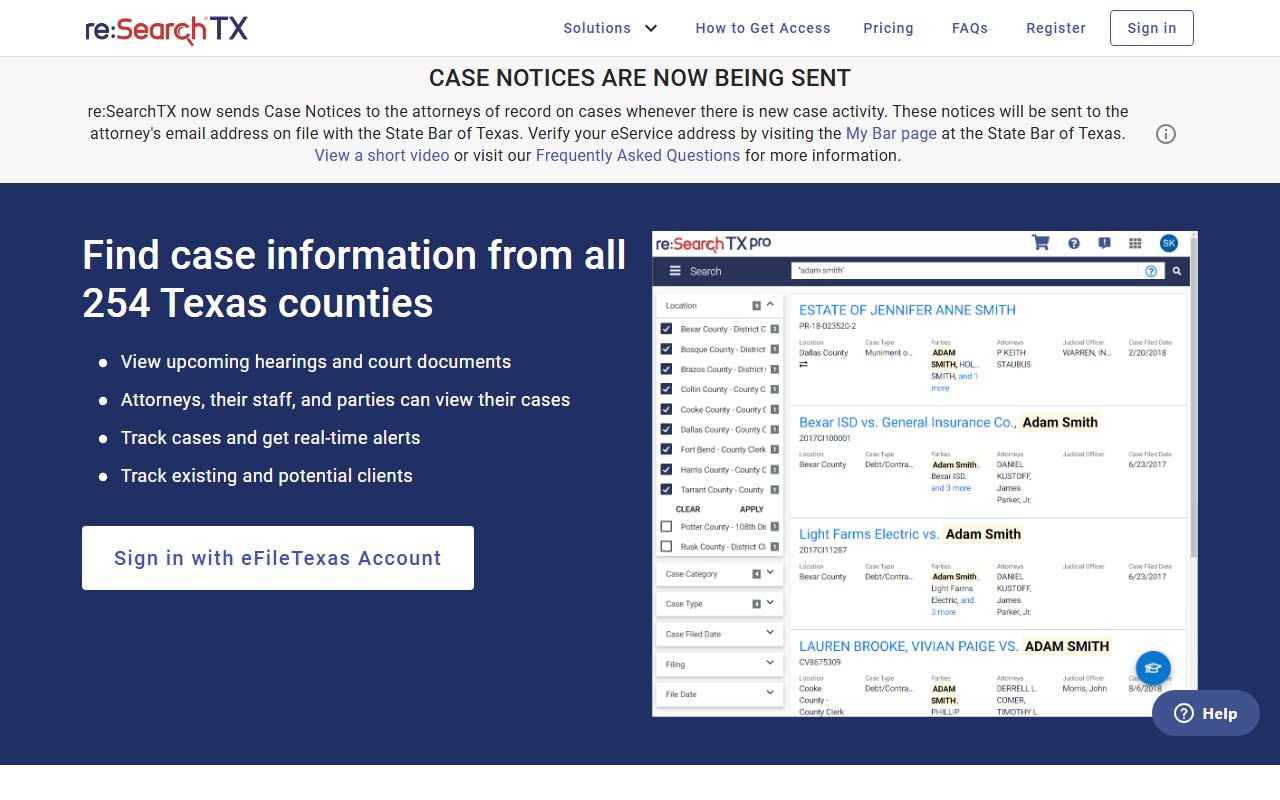
Use the portal as one search channel, then confirm Throckmorton-specific criminal filings with the County Clerk, District Clerk, or JP court when coverage or document access is limited.
| re:SearchTX Field | Type | Required | Use for Throckmorton Cases |
|---|---|---|---|
| Search type / case search | Portal controls | Account and coverage dependent | Use for statewide court-record searching where county data is available. |
| Name | Text | Varies | Search by defendant name when a case number is unknown. |
| Case number | Text | Varies | Use a number from clerk records, bond paperwork, citation paperwork, or the roster warrant/case field. |
| Location / county | Filter | Varies | Choose Throckmorton County when available, but expect clerk contact for some records. |
| Login / account | Registration | May be required | Some portal functions and documents can require account access or can be restricted. |
How Charges Get Filed After an Arrest: Complaint, Information, and Indictment
The first charge text a family member sees may be a jail roster description, not the final charge in the court record. After a Throckmorton County arrest, Article 15.17 requires magistration without unnecessary delay, generally within 48 hours, for warnings, probable cause, and bond handling. Prosecutors then decide what charging document to file. The 39th Judicial District Attorney, Mike Fouts, handles felony and district-level matters. The County Attorney page lists Kris Fouts, Pro Tem, but does not publish a detailed division chart.
| Document | Filed By | Common Use | What to Check |
|---|---|---|---|
| Complaint | Officer or prosecutor, depending on the proceeding | Can support arrest, magistration, or the start of a criminal case | Alleged facts, defendant name, offense date, and probable-cause language. |
| Information | Prosecutor | Often used for misdemeanor prosecution and some cases where indictment is not required | Filed charge, statute, count language, and any later amendments. |
| Indictment | Grand jury | Felony matters requiring grand-jury action | Count numbers, felony level, enhancement language, and district court assignment. |
Charge Status in Court Records After an Arrest
Charges can change after the jail record appears. The Stephens roster can show a statute, description, warrant number, count, and bond amount, but the prosecutor may later file a different charge, reduce it, add another count, dismiss it, or replace it with an indictment or information. That is why a Throckmorton court-record search should compare the jail roster entry against clerk records and court orders instead of assuming the arrest wording is final.
| Status | What It Means |
|---|---|
| Pending | The court case has been filed or remains active, and no final dismissal, plea, trial result, or judgment has resolved that charge. |
| Amended / Reduced | The filed accusation changed. The description, statute, offense level, or count may differ from the booking charge first shown on the jail roster. |
| Dismissed | The charge ended without a conviction on that count. A dismissal is still a court record unless it is later sealed, expunged, or otherwise restricted by law. |
| Nolle Prosequi | The prosecutor declined to continue the charge. Texas records may use different docket wording, so confirm the exact disposition with the clerk. |
| Convicted / Judgment | A plea, verdict, or judgment resulted in a conviction or other final court disposition. This is different from an arrest or pending charge. |
Bond and Release After an Arrest
Bond information in a court record should be verified with the court, clerk, magistrate, or jail before travel or payment. Stephens roster examples showed large numeric bond amounts, NOT SET, DENIED, and REDACTED in different views. Released 24-hour records can redact total bond while individual charge rows still show amounts. Texas Code of Criminal Procedure Chapter 17 controls bail and bond rules, while Article 15.17 controls magistration after arrest. A hold from another county, TDCJ parole, ICE, federal authorities, or a bench warrant can block release even when one charge appears bondable.
| Bond Type | How It Works |
|---|---|
| Cash Bond | Money is paid directly, often for the full amount, subject to the court's rules and any local fees or payment limits. |
| Surety Bond | A licensed bail bond company posts the bond for a fee after confirming the person is eligible for release. |
| Personal Bond / PR Bond | The defendant is released on a promise to appear and comply with conditions, without posting the full cash amount. |
| Property Bond | Property is pledged as security when allowed by the court and accepted under the applicable procedure. |
| No-Bond Hold | Ordinary bond posting will not release the person. A parole blue warrant, fugitive hold, bench warrant, detainer, or court denial may be involved. |
| Not Set | The roster may show no amount before magistration or before the bond entry has been updated. |
Warrants That Lead to an Arrest
No official Throckmorton County active warrant list was found on the sheriff or court pages reviewed. The local starting point for sheriff-held warrant questions is the Throckmorton County Sheriff's Office at 940-849-8855. For court-issued warrants, call the court that issued the warrant: JP court at 940-849-8830 for JP criminal and Class C matters, or the County Clerk/District Clerk at 940-849-8815 for filed criminal cases and court records. The Stephens jail roster may show warrant-related fields if a warrant arrest resulted in booking or housing.
| Warrant Type | Plain-English Meaning |
|---|---|
| Arrest warrant | A judge-authorized warrant connected to a new alleged offense, complaint, or investigation. |
| Bench warrant | A warrant issued by a court, often after a failure to appear or violation of a court order. |
| Capias / capias pro fine | A Texas court warrant tied to taking a person before the court or enforcing unpaid fine and court-cost obligations. |
| Blue warrant | A parole-violation warrant. Research found a BLUE WARRANT example in Stephens roster data. |
| Fugitive warrant / hold | A hold or warrant connected to another jurisdiction. The inspected Throckmorton Sheriff's Office roster sample included a fugitive-from-justice row. |
| Detainer | A request from another agency to keep custody or notify that agency before release. |
Charges vs. Convictions
An arrest charge is an accusation. A court conviction is a final result after plea, verdict, or judgment. That distinction matters when reading Throckmorton County court records after an arrest, because a roster entry can look serious even when the prosecutor later dismisses, changes, or cannot prove the charge. Public court records can show both unresolved accusations and final convictions, so the disposition field is essential.
| Charge | Conviction | |
|---|---|---|
| Stage | Accusation after arrest, complaint, information, or indictment. | Final court result after plea, verdict, or judgment. |
| Burden of Proof | Earlier stages may rely on probable cause or filed allegations. | Requires proof beyond a reasonable doubt or a knowing plea accepted by the court. |
| Record Meaning | Shows what was alleged and filed, not that the person was guilty. | Shows the court's final adjudication or judgment for that offense. |
| Where to Verify | Clerk docket, prosecutor filing, bond paperwork, and court orders. | Judgment, sentence, DPS conviction search, or TDCJ record if sentenced to state custody. |
Sealed vs. Expunged Arrest Records
Texas Code of Criminal Procedure Chapter 55 governs expunction of qualifying arrest records. Expunction is different from ordinary privacy, redaction, or a sealed view. If a Throckmorton arrest is dismissed or otherwise becomes eligible, the controlling path is a court order and notice to agencies that hold the records. A public roster entry or third-party copy should not be assumed to disappear automatically.
| Sealed / Restricted | Expunged / Expunction | |
|---|---|---|
| Visibility | Public access is limited or hidden, but the record may still exist for authorized uses. | Qualifying records are ordered removed, destroyed, or treated under the expunction order process. |
| Law Enforcement | Some agencies or courts may retain access depending on the order and law. | Access is much more limited and controlled by the Chapter 55 order and related procedures. |
| Best Starting Point | Clerk record, court order, and any applicable nondisclosure or restriction process. | Texas Code of Criminal Procedure Chapter 55 and the court that can issue the expunction order. |
| Effect on Online Data | May remove or restrict public display where the order applies. | Requires following the court order process with agencies that hold the arrest, booking, or court record. |
Background Check Considerations
Texas Government Code Chapter 552 makes many government records requestable, but public access is not the same as a compliant employment, housing, credit, insurance, or tenant-screening background check. A clerk search, jail roster, or casual name lookup can be incomplete, outdated, or missing final dispositions. For a Throckmorton arrest, verify the court record with the office that filed or maintains the case before treating the information as current.
Important: Casual lookup results are not consumer reports and cannot be used for FCRA-covered decisions.
Restricted Court Records After an Arrest in Throckmorton County
Not every record connected to a Throckmorton arrest is open in the same way. Texas Government Code Section 552.108 can protect law-enforcement information in some situations, although subsection 552.108(c) preserves access to basic information about an arrested person, an arrest, or a crime. Juvenile matters, medical or mental-health details, victim information, confidential identifiers, ongoing investigations, sealed cases, and expunction-covered records may be withheld or redacted. The practical rule is to separate basic arrest information from the full investigative file and to ask the holding agency or clerk what can legally be released.